 Strike Guard LWS

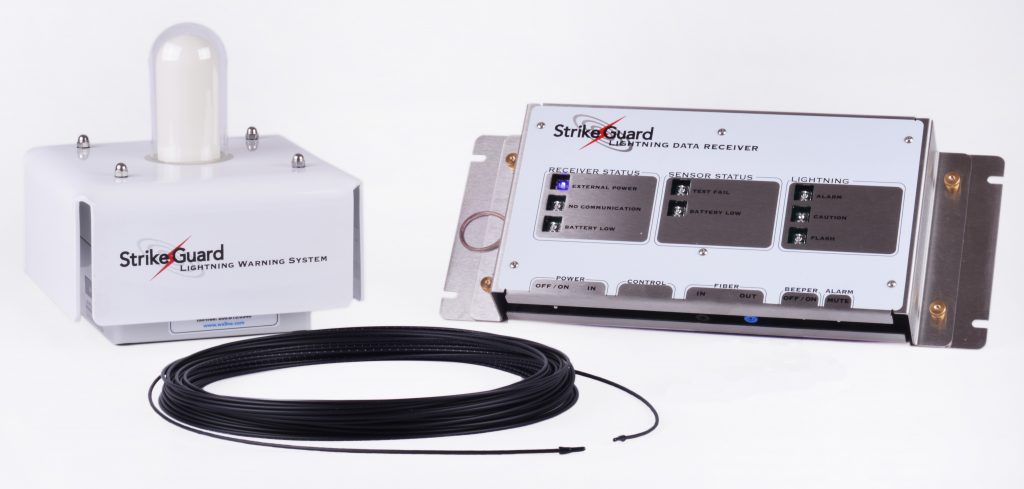
Designed for the most critical safety and productivity management applications, Strike Guard is a purpose designed lightning threat detection system which continuously monitors cloud to cloud (C-C) and cloud to ground (C-G) lightning activity, and provides contact closure signaling at user set lightning activity thresholds, for autonomous threat notifications .
Patented optical signal processing and proprietary optical threat validation ensures that any notified Lightning Alert must have passed through a double positive coincidence between two (2) independent lightning sensors, before any threat is notified, therefore ensuring 100% zero (0) false alarm rate.
Strike Guard enables 100% automated activation of various proprietary and third-party threat notification systems for:
- ensuring whole of site human safety,
- controlling the initiation of data backup and system shutdown.
- controlling generator start-up prior to localized conditions,
- sequenced electrical isolation of critical electrical systems, for the duration of an electrical storm.
Strike Guard is a Class II lightning threat detection system which detects historical Cloud to Cloud (C-C) flashes, and Cloud to Ground (C-G) lightning strikes, and ranges these events across 3 distance based thresholds;
Caution Lightning Detected within 32 Kms Referred to as Yellow Alert
Warning Lightning Detected within 16 Kms Referred to as Amber Alert
Alarm Lightning Detected within 8 Kms Referred to as Red Alert
Strike Guard includes two (2) presetable relays contact closures that can be configured to interface a proprietary WAVE Siren Transmitter (for autonomous control/operation of WAVE Siren Strobe Stations, which via a wireless means can be stationed across different areas of workplace operations, and can provide audible and visual threat notifications to within a 5 km range.
The Strike Guard Lightning Data Receivers main and Auxilliary Relays can be configured to provide a sequenced operation of proprietary WAVE, or 3rd party threat notification options at:
Caution Lightning detected within 32 km.
Warning Lightning detected within 16 km.
Or
Caution Lightning detected within 32 km.
Alarm Lightning detected within 8 km.
Alternatively, for those sites that require three (3) stage warnings, this is also possible, although does require an additional purchase of an addditional Lightning Data Receiver, that is then wired in series with the existing Strike Guard Lightning Data Receiver, which can then be configured for sequenced operation of proprietary WAVE, or other 3rd party threat notification options at:
Caution Lightning detected within 32 km.
Warning Lightning detected within 16 km.
Alarm Lightning detected within 8 km.
Strike Guard offers:
- Automatic alarm triggering with user set range categories.
- No false alarms, patented technology.
- Sensor and communication self-test.
- Battery-powered with five (5) year minimum battery lifespan, allowing for easy installation and electrical isolation.
- Nema 4X sensor enclosure.
- Fibre optic communication from the sensor allows for a completely isolated integration; no electrical conductors enter the command and control buildings.

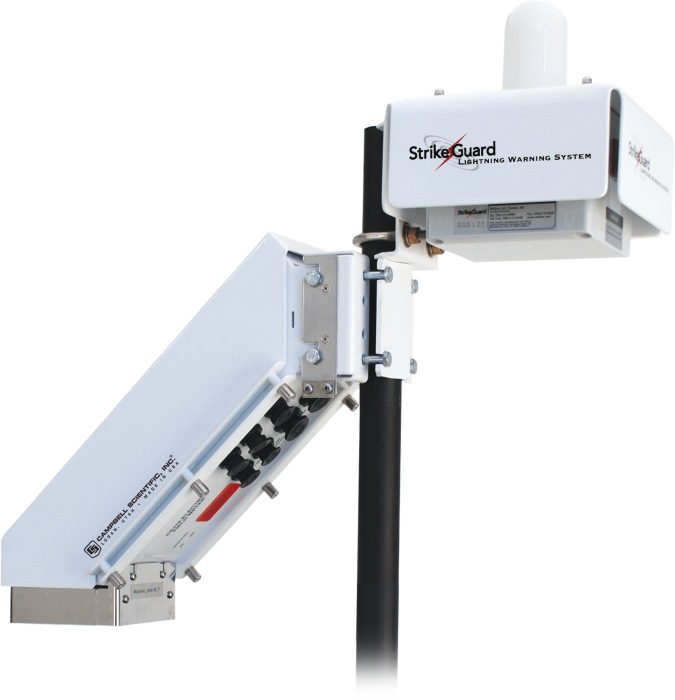
The Strike Guard Lightning Warning System and CS110 Electric Field Mill combine to present the optimum level of lightning threat management measurement, where data from the two (2) sensors (Class I Pedictive and Class II Historical) can be used to automatically trigger the proprietary WAVE Siren transmitter to activate all WAVE Siren Strobe Stations/3rd party equipment located within a 5 km radius, so as to immediately notify exposed personnel to make informed safety and evacuation decisions.
During the development and evolution of localsed thunderstorms, fluctuations and changes within the local electric field (E Field) occurs naturally where a Class I Lightnimng Sensor can be used to sense, measure, and then determine the likelihood that impending lightning activity may occur.
The CS110 EFM can measure these fluctuations and changes within the local electric field (E Field) and can compare the readings against a benchmark E Field threshold, that can be actioned by Strike Guard in any event of a threshold breach.
Strike Guard is a class II historically reporting lightning threat detection system, although it has been designed so as to integrate and harmonize threat notifications from an optional Class I Electric Field Mill, which now adds a predictive aspect to threat notifications, in conjunction with its historical ranging of lightning strikes, where the two (2) sensors combine to form a complete thunderstorm measurement and analysis system.
This system combines the advantages of two complementary lightning-warning technologies. Where Strike Guard reports actual lightning strikes occurring at distances up to 32 km—providing a comfortable warning time for preparations associated with incoming storms., whilst CS110 reports electric fields associated with local thunderstorm development—providing its warning prior to lightning strikes.
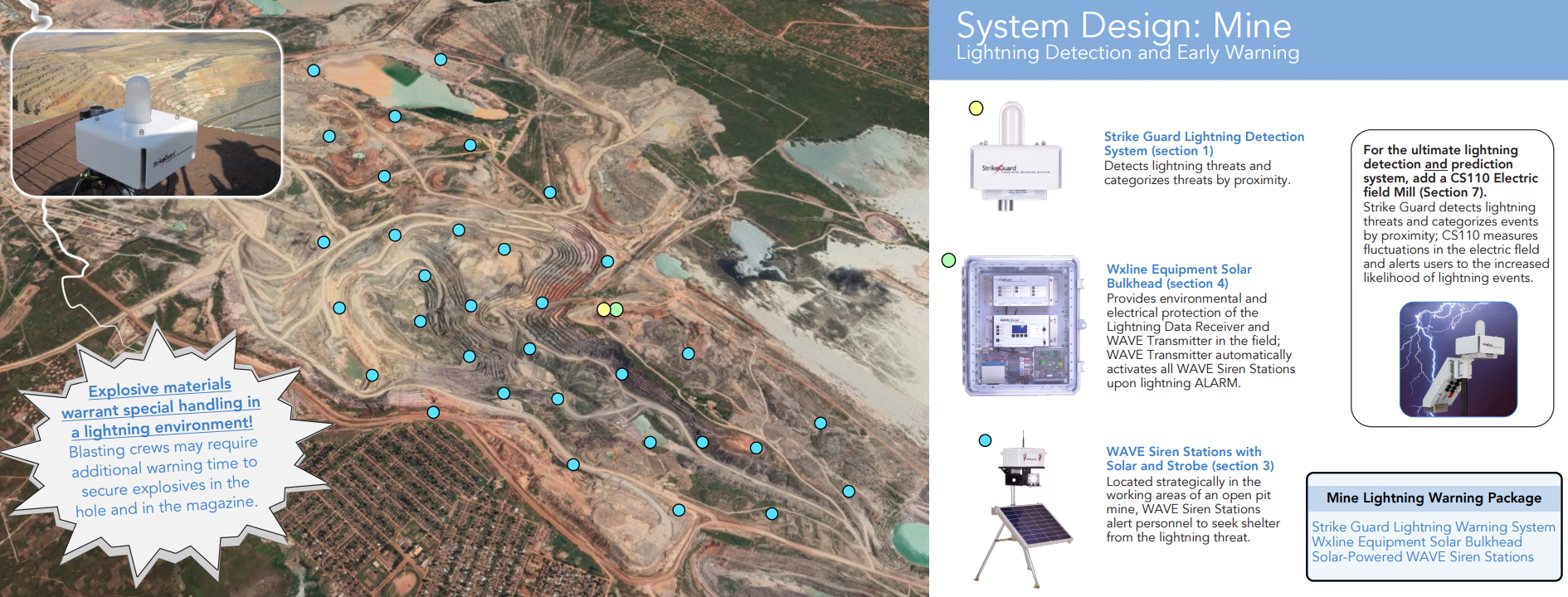
Strike Guard for Mining Operations
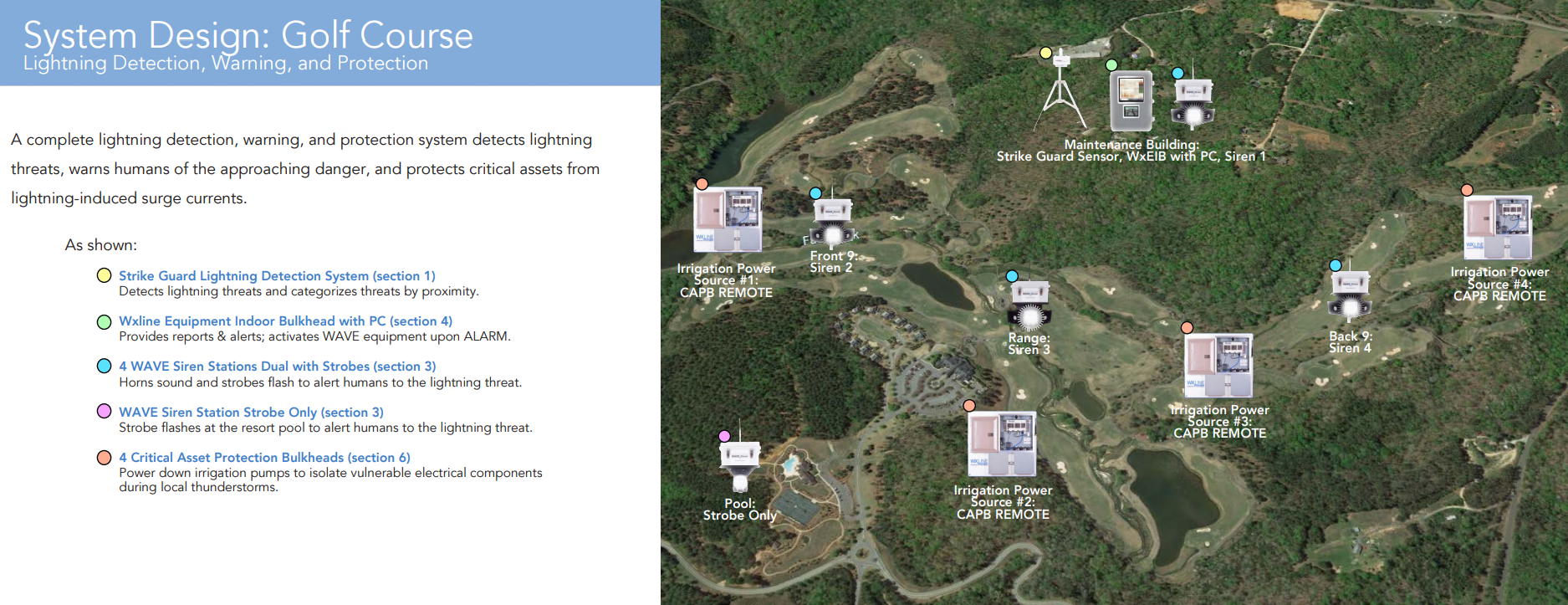
Strike Guard for Golf Courses